Proportions Over Rules: The Styling System That Replaced Body-Type Boxes
Quick Answer: The body-type fruit system (pear, apple, hourglass) is being replaced by proportion styling — the same geometry, without the assumption that everyone’s goal is to look like an hourglass. Learn four universal principles (volume vs. fit, horizontal vs. vertical lines, the waist dial, the rise line), then test them on your own body with fitting-room photos and decide what effect you want.
Somebody once decided that human bodies come in five varieties, all of them fruit, and that four of them should be dressed to look more like the fifth.
That system is quietly retiring, and good riddance. What’s replacing it keeps everything the old rules got right about geometry and throws out the part where a stranger decides your destination.

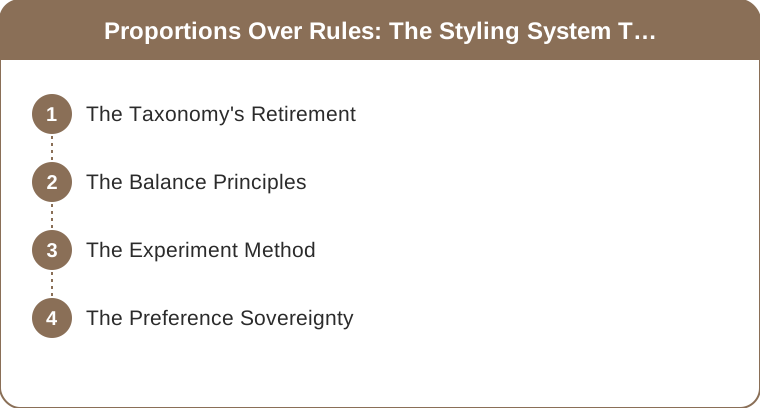
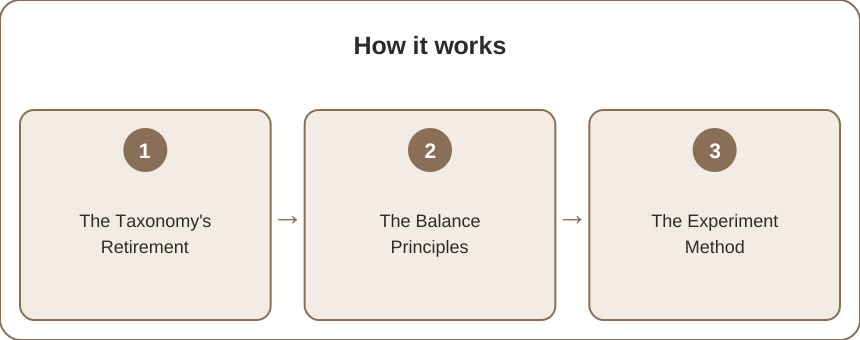
Why Are Body-Type Rules Falling Out of Favor?
Three specific problems, and none of them is that the geometry was wrong.
Bodies don’t fit in four boxes. Most people reading a body-type quiz end up between two categories, or find their measurements say one thing and their reflection says another. A taxonomy that leaves most of its users uncertain isn’t doing its job.
Every prescription assumed the same goal. Read the old advice carefully and you’ll notice all roads lead to approximating an hourglass. Nobody ever asked whether that’s what you wanted. If your goal is to look longer, or stronger, or softer, or simply comfortable, the fruit chart had no answer for you.
The word “flattering” smuggled in an apology. “Flattering” almost always meant “makes you look smaller here.” It framed styling as concealment, which is a joyless way to get dressed.
The proportion system keeps the useful physics and drops the mandatory destination.
What Are the Four Balance Principles?
These are body-neutral. They describe how lines and volume behave in space — where you choose to apply them is entirely personal.
1. Volume plays against fit. If one half of an outfit is oversized, the other half is fitted. Oversized blazer with slim trousers, or a voluminous skirt with a fitted top. Oversized on oversized reads as bulk on every single body — this is the closest thing to a universal rule in styling.
2. Horizontal lines widen where they land; vertical lines lengthen. A hem, a waistband, a stripe, a color break — each draws the eye across at that exact point. An open jacket, a long necklace, a center seam, a monochrome column all draw the eye up and down. The geometry is neutral. Where you place it is your call.
3. The waist is a dial, not a duty. You can define it, ignore it, or place it somewhere other than your anatomical waist. Empire, dropped, and cinched are all just different dial settings. There’s no default position you owe anyone.
4. The rise line is drawable. Where your trousers or skirt sits determines where your legs appear to start — and it can be moved. A high rise with a tucked top starts the leg line higher; a low rise starts it lower. This works at every proportion, which is precisely why it’s a tool rather than a rule.

How Do You Test This on Your Own Body?
Turn the fitting room into a lab. The method is simple and it beats every inherited rule.
Change one variable at a time. Same outfit, two different rises. Same top, tucked versus untucked. Same trouser, two hem lengths. If you change three things at once you learn nothing.
Photograph each version. Front and side, same spot, same light. This matters more than it sounds — mirrors are processed emotionally in a way photos aren’t, and you’ll see proportion far more accurately in a picture.
Log the result as personal data. Not “pears should wear X.” Write down: “high rise + French tuck works on me.” That’s evidence from the only body it needs to apply to.
Repeat until you have five or six reliable formulas. That’s a personal style system, derived from your own testing rather than from produce. It takes maybe three or four fitting-room sessions to build.
A practical starting experiment, since it’s the highest-yield one: take the same top and photograph it untucked, fully tucked, and half-tucked over a high waist yoga pant or your usual high-rise jeans. The difference in where your leg line appears to start is usually dramatic, and it’s the single most transferable thing you’ll learn about your own proportions.
Myth vs Fact
Myth: You need to know your body type before you can dress well. Fact: You need to know your measurements and your preferences. The category label adds nothing the measurements don’t already tell you.
Myth: Some styles are universally unflattering. Fact: Every “never wear this” rule has been broken beautifully by someone who wanted that exact effect. The rules describe tendencies, not prohibitions.
Myth: Vertical stripes make you look taller. Fact: Vertical lines — seams, plackets, an open jacket, a monochrome column — do far more than printed stripes, which sit flat and often follow the fabric’s drape instead of your body’s line.
Myth: The goal is always to create an hourglass. Fact: The goal is whatever you decide it is. Elongating, emphasizing, balancing, or just wearing what feels good are all legitimate outputs of the same geometry.
The Part That Actually Changed
The upgrade isn’t in the physics. It’s in who holds the remote.
Instead of asking “is this flattering?”, ask: “does this create the effect I want?” That single rephrasing does most of the work. It turns styling from a test you can fail into a tool you’re operating.
And the answer to “what effect do I want?” can legitimately be elongate my legs, or emphasize my shoulders, or feel comfortable and stop thinking about it. All four are valid, all four are achievable with the same four principles, and none of them require you to identify as a fruit.
Keep the geometry, drop the destination, test on your own body, choose the goal. The old rules weren’t wrong about lines. They were wrong about who decides where the lines go.
Mini FAQ
Is body-type styling completely useless?
Not useless — the underlying geometry about lines and volume is genuinely sound and still works. What’s outdated is the assumption that everyone shares the same goal and that certain shapes need correcting.
How do I know what proportions I actually have?
Measure your shoulders, bust, waist, hips, and inseam, and note where your natural waist sits relative to your torso. Those numbers plus fitting-room photos tell you more than any quiz, and they don’t require you to pick a category.
What if two principles seem to conflict in one outfit?
Let your stated goal break the tie. If you want to look longer, prioritize the vertical line; if you want to emphasize the waist, prioritize the horizontal one — you don’t have to satisfy every principle at once.
TL;DR:
- Fruit-based body types are retiring because bodies exceed four boxes and every prescription assumed one goal.
- Four body-neutral principles: volume vs. fit, horizontal widens / vertical lengthens, the waist is a dial, the rise line is drawable.
- Test one variable at a time in the fitting room and photograph it — mirrors lie, photos don’t.
- Log results as personal data, not universal rules.
- Replace “is this flattering?” with “does this create the effect I want?” You pick the goal.
Keep Reading
This article is for general styling and informational purposes only. Trends, sizing, availability and pricing may vary by brand and season.